
U.S. Naval War College Holds Annual Army-Navy Flag Football Game
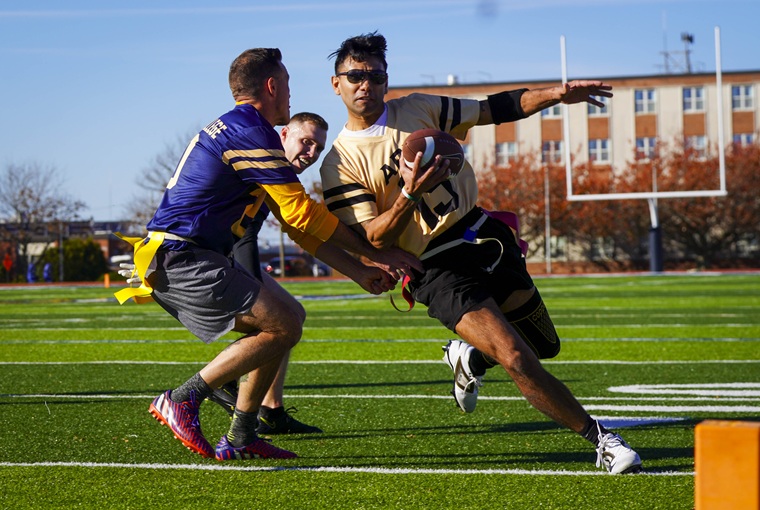
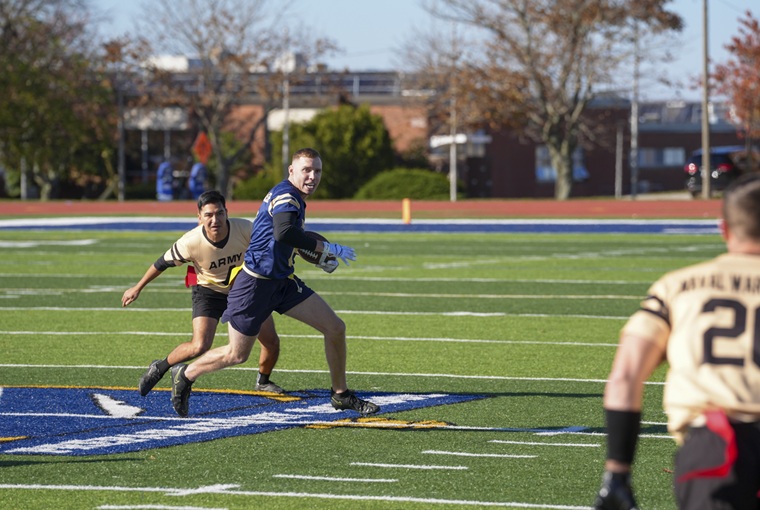
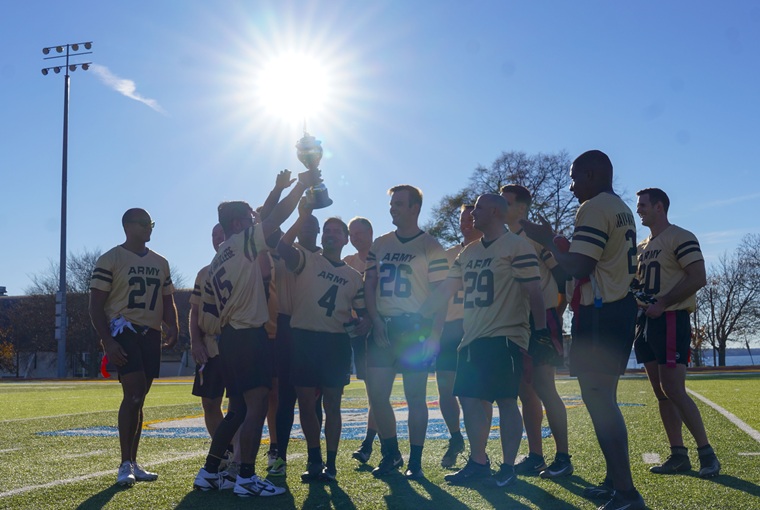
The U.S. Naval War College (NWC) held its annual Army-Navy flag football game at Nimitz Field aboard Naval Station Newport in Rhode Island on Wednesday, Nov. 18, 2026.
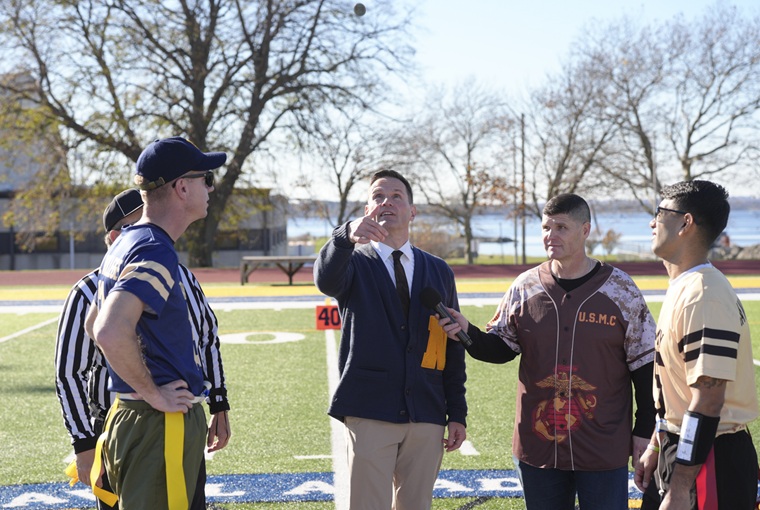 “The U.S. Naval War College’s Army-Navy flag football game is an annual tradition that promotes fitness, camaraderie and the eternal good-natured rivalry between our services,” said NWC President Rear Adm. Darryl Walker. “Just as important, this game highlights leadership, strategy and coordination in a very accessible, tangible way. Some of the principles and theories we discuss in classrooms are on display here on the gridiron – with the added benefit of a stiff workout. Many thanks to the Naval War College Foundation for their support of the tailgate festivities prior to kick-off.”
World War I hero and two-time war college President Rear Adm. William S. Sims famously likened wargaming to football practice and wrote that “high-brow theoretical studies” of naval strategy should be “reduced to its simplest terms into a doctrine much like the whole repertoire of plays used in football.”
But according to the research of College of Maritime Operational Warfare Professor and retired U.S. Navy Cmdr. David Kohnen, Ph.D., NWC’s Capt. T.B. Kittredge Historian, that’s not where the admiral’s – and the war college’s – connection to the sport ended.
 Building off a prior relationship with Navy reservist, burgeoning professional football team leader and future Hall-of-Famer George Halas, Sims gave a 1920 talk on leadership and organization to a group of team owners.
The speech set the stage for follow-on meetings in Canton, Ohio, which resulted in the formation of what would become known as the National Football League.
The curricular reforms Sims instituted in the classroom setting, as well as the wargaming priorities he championed, continue to be a significant part of today’s Naval War College programming to this day.
Established in 1884, NWC informs today’s decision-makers and educates tomorrow’s leaders by providing educational experiences and learning opportunities that develop their ability to hedge aggressively, innovate continuously, fight distributively, delegate confidently, and command with clarity within complex battlespaces.
About this News Article
Article Information
November 24, 2026
Most Recent
News, Media, & Events
President’s Spotlight: Dr. Charlotte Hulme, the Rear Adm. Richard E. Byrd Funded Chair for Polar Studies
Nov. 23, 2026
News Publication
U.S. Naval War College Welcomes Royal Bahamas Defence Force, Rhode Island National Guard
Nov. 24, 2026
News Publication
Issues in National Security: "FDR and the Coming of the Pacific War"
Dec. 08, 2026
4:30 PM
Spruance Auditorium, U.S. Naval War College, 686 Cushing Road, Newport, RI 02841
Rethinking Wargaming Design and Analysis in the Modern Age: Lessons Learned from Global 21
Nov. 05, 2026
Center for International Maritime Security (CIMSEC)
Article Publication