
Naval War College Students Present Research on Contested Logistics Policy, Industrial Competition and Preparing for Algorithmic War
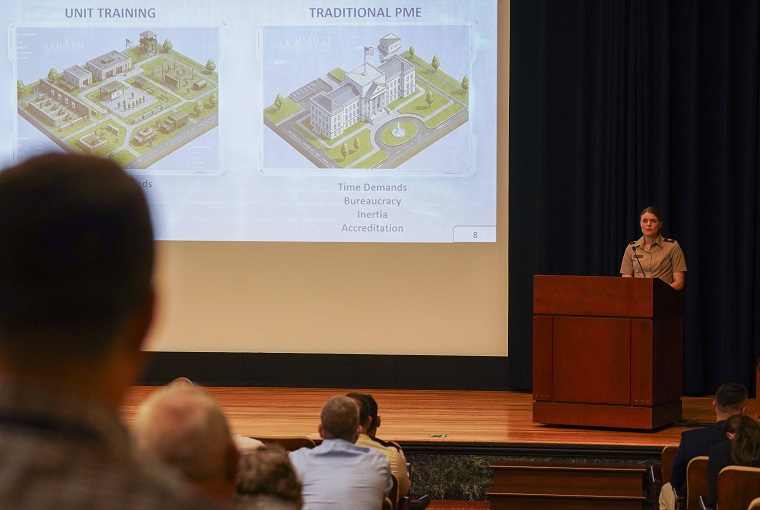
Thirteen U.S. Naval War College (NWC) students – two teams of six and one solo officer – presented their responses to the Deputy Secretary of War and Vice Chairman of the Joint Chiefs of Staff Advanced Research Challenge on May 25, 2026, at the war college’s Newport, Rhode Island, campus.
In response to prompts issued by the offices of the Deputy Secretary of War and Vice Chairman of the Joint Chiefs of Staff, the researchers worked with NWC faculty on the projects throughout the academic year, above and beyond their Joint Professional Military Education certification and master’s degree course loads.
NWC President Rear Adm. Darryl Walker was among the war college staff, faculty and students who gathered in historic Pringle Hall to listen to the researchers present their findings. Associate Provost for Research Dr. Jeremiah Ross Dancy introduced the program.
 “The research generated by our faculty-student teams participating in the Advanced Research Challenge is of exceptionally high quality and directly relevant to current joint force challenges,” said Dancy. “This is not simply academic work: these teams engage with complex problems that leaders in the Pentagon and in operational commands are actively working to solve. Research produced through this program has informed important decisions and contributed meaningfully to how the joint force approaches pressing challenges.
“The program is equally valuable for our students,” he continued. “They develop deep expertise on consequential issues, learn how rigorous research can support real-world decision-making, and build professional relationships that will serve them throughout their careers.”
The first group to present – consisting of Cmdr. Sara Neugroschel, Cmdr. Anthony Morana, Cmdr. Sean Norton, Lt. Col. Todd Richardson, Lt. Col. Aaron Ritzema, and Peter Teague – discussed their research into how cyber effects and information warfare can be used to disrupt, delay and deny an adversary’s military industrial base to reduce any gaps in production while U.S. industry increases output to meet wartime demand.
U.S. Army Maj. Sarah Long then presented her proposal to develop a standalone military education program to uniquely train algorithmic warfighters – military leaders who can plug into smaller, decentralized and survivable command teams that control vast networks of force-multiplying artificial intelligence tools and unmanned systems, adapting in real-time to operational environments.
The third group – consisting of Cmdr. Sonny Rowland, Lt. Col. Jenna Rederus, Lt. Col. Brian McCarthy, Lt. Col. Bryan Hole, Dr. Winnifred Warren and Abigayle Yocom – presented their research on removing policy barriers to extending supply chains deeper into the Indo-Pacific theater, by increasing pre-positioned and forward-deployed supplies and shifting command of sustainment operations under wartime conditions to ensure allocation of resources matches operational needs.
Assoc. Prof. David Brown, a retired U.S. Army colonel and executive director of the Advanced Naval Strategist Program, served as the faculty advisor on the first two projects. Joint Military Operations Department professors Jamie Gannon, a retired U.S. Marine Corps colonel, and U.S. Navy Cmdr. Jonathan Durham served as advisors on the third project.
“It’s clear that the military leaders here who tackled these challenging issues considered all angles and developed usable strategies that, if fleshed out and pursued, would make the U.S. even more dominant and effective on the global stage,” Walker said. “Our warfighters dug into contested logistics, military industrial competition and the future of AI in C2 – all complex problem sets with no easy answers.
“Every day, the students, faculty and staff at the U.S. Naval War College are taking the latest and highest-level military priorities and working tirelessly to not only become experts, but to innovate and be ready to lead forces to victory on tomorrow’s battlefields,” he continued.
The 2025-26 Advanced Research Challenge was the fourth iteration of the program, calling for entries from all 19 military education institutions across the U.S. to respond to any of five prompts released in May of 2025. Each year, four winning projects are chosen to be presented to senior military leaders in Washington, D.C.
In the first three years of the challenge, four research teams from the Naval War College have been chosen as winners.
Established in 1884, NWC informs today’s decision-makers and educates tomorrow’s leaders by providing educational experiences and learning opportunities that develop their ability to hedge aggressively, innovate continuously, fight distributively, delegate confidently, and command with clarity within complex battlespaces.
About this News Article
Article Information
May 26, 2026
Most Recent
News, Media, & Events
U.S. Naval War College’s Cardines Classic Baseball Game Builds Camaraderie, Strategic Thinking
May. 11, 2026
News Publication
U.S. Pacific Fleet Commander Adm. Koehler Awarded Distinguished Graduate Leadership Award
May. 14, 2026
News Publication
2026 CIWAG Maritime Symposium: Gathering Storms & Shifting Tides
Jun. 22, 2026
7:00 AM
Wyndham Hotel, 240 Aquidneck Ave, Middletown, RI 02842
Restrain and Hedge: A New U.S. Nuclear Strategy for a Two-Peer World
May. 15, 2026
War on the Rocks
Article Publication