
U.S. Naval Forces Europe & Africa Launches Euro-Atlantic War Game 2026 at U.S. Naval War College

NEWPORT, R.I.— The U.S. Naval War College (NWC) launched the Euro-Atlantic War Game 2026 (EA-26), a multi-war game series supporting U.S. Naval Forces Europe and Africa (NAVEUR/AF), with initial events taking place in December 2025 and January 2026.
“This work not only improves our ability to deliver maximum lethality in the near-term, but also shape the way we view and prepare for conflict in the long-term,” said Adm. George M. Wikoff, Commander, U.S. Naval Forces Europe-Africa. “EA-26 gives us an understanding of how to fight as a coherent, combined maritime force while supporting both the Joint Force as well as Allies and partners. We need clear understanding about which combinations of force packages succeed, which falter, and when U.S. enabling capabilities are decisive.”
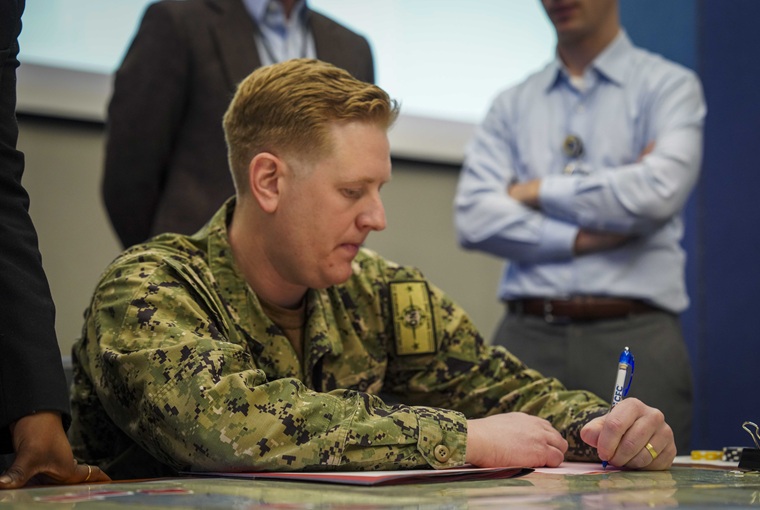 The war game’s first line of effort aims to understand integration and sequencing of allied maritime forces, Special Operations Forces, and unmanned systems in the Baltic Sea region to maximize effectiveness and lethality. The effort marks an evolution toward continuous, iterative wargaming that produces insights for the purposes of improving fleet agility.
“As a former (Special Operations Command Europe) maritime operations planner, I frequently collaborated with EUCOM, NAVEUR, and SOF Allies and partners to integrate uncrewed systems and other nuanced concepts to achieve theater objectives,” said Cmdr. Sean Norton, a student at the war college and participant in the war game. “However, we lacked a common forum to test and iterate with experimental concepts. EA-26, and similar games, offer a unique opportunity to bring relevant planners together to develop and test novel ideas to offer joint and combined solutions to mitigate risk to U.S. security interests. These games are important for designing new technologies into operations for which current doctrine and plans may lack sufficient employment frameworks.”
In the initial December event, more than 40 participants — including NWC faculty, students, and retired flag officers — worked through a series of short, structured matrix games exploring crisis and conflict scenarios. Five parallel teams sequenced actions and effects, and integrated capabilities against adversary teams attempting to disrupt access and tempo. The iterative design enables comparison across several dozen game runs rather than relying on a single event’s insights.
Lt. Julia Leighton, a surface warfare officer enrolled in the war college’s yearlong Maritime Advanced Warfighting School (MAWS), said the game has helped amplify “the increase in firepower that comes with effective decision making.”
“The EA-26 games gave a huge advantage to the participants to understand joint partners' capabilities, and I believe all of us left with new ideas on how to implement tactical capabilities across borders, time, and space,” she said. “Something that will directly improve my individual research is the sequencing elements that we played with, especially with the causation and effects on other warfare areas, as well as how we balance risk and priorities on the fleet level.
 EA-26 also blends wargaming with advanced analytic methods. The game uses common scenarios, rule sets, and decision structures across its iterations, allowing analysts to track player decisions, interactions, and outcomes with precision. Mixed-methods analysis—including thematic coding, regression, and Monte Carlo simulations—helps identify force combinations that work most often, the ones that face challenges, and highlighting potential underlying mechanisms driving both.
“This series embodies what the U.S. Naval War College is built to do — bring together operators, scholars, and students to generate meaningful insights for fleet commanders,” said NWC President Rear Adm. Darryl Walker. “Euro-Atlantic challenges require disciplined analysis and unity of effort across the Alliance. EA-26 addresses both.”
EA-26 events in early 2026 will bring in operational planners from NAVEUR/AF, Marine Forces Europe and Africa, Special Operations Command Europe, and the intelligence community to allow current theater practitioners to employ the same forces and concepts. EA-26 will conclude at the end of March, with the U.S. Naval War College delivering a comprehensive assessment in the spring.
Founded in 1884, NWC informs today’s decision-makers and educates tomorrow’s leaders by providing educational experiences and learning opportunities that develop their ability to anticipate and prepare strategically for the future, strengthen the foundations of peace, and create a decisive warfighting advantage.
About this News Article
Article Information
February 10, 2026
Most Recent
News, Media, & Events
College of Maritime Operational Warfare Graduates Winter Executive Level Operational Level of Warfare Course
Jan. 30, 2026
News Publication
Chief of Naval Operations Announces Navy’s “Fighting Instructions” During Address at U.S. Naval War College
Feb. 09, 2026
News Publication
Current Strategy Forum
Jun. 08, 2026
8:00 AM
Hybrid Event
Four Takeaways from Donald Trump’s National Defense Strategy
Feb. 07, 2026
The National Interest
Article Publication