
Cyber & Innovation Policy Institute Partners with The Army Cyber Institute at West Point on a Special Issue of The Cyber Defense Review
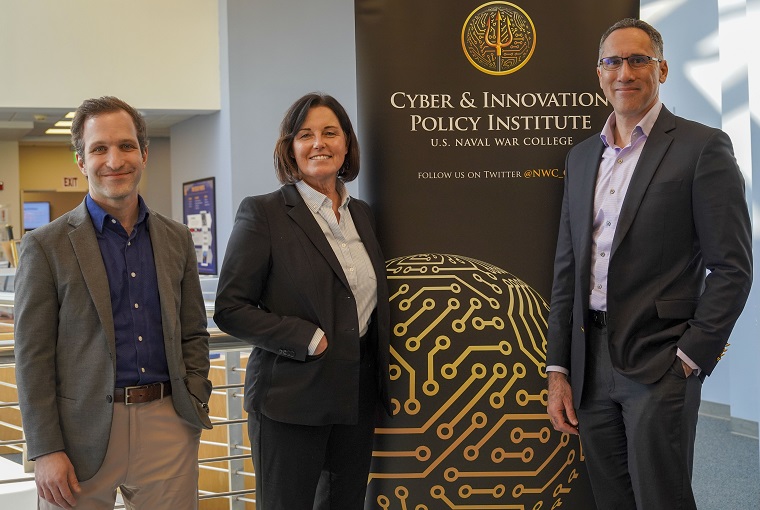
Three professors from the Cyber & Innovation Policy Institute (CIPI) at the U.S. Naval War College (NWC) served as guest editors for a special issue of The Cyber Defense Review focusing on the future of U.S. cyber forces.
Alongside openly solicited submissions, the December publication featured authors from the annual CIPI Summer Workshop held at NWC from May 28-30, 2025, titled “CYBERCOM.Next?” This workshop brought together select academics, practitioners, and government officials to consider how emerging technology, military innovation, and the nature of the cyber threat have impacted the development, performance, and future of U.S. Cyber Command (USCYBERCOM).
Participants in the workshop examined cyber force generation and use through analytical wargaming, panel discussions, and policy debate. Following this event, Prof. Frank L. Smith III, director of CIPI, and fellow CIPI faculty members Prof. Chris Demchak and Associate Prof. Mike Poznansky served as the guest editors for the special issue.
The guest editors, in coordination with The Cyber Defense Review editorial team, curated a diverse collection of peer-reviewed research, professional commentaries, and senior leader perspectives. They adjudicated the peer-review feedback for research articles, ensuring authors addressed reviewer critiques to strengthen and finalize their manuscripts. To frame the special issue, the editors provided a comprehensive introduction and conclusion, summarizing the findings and proposing directions for future study.
“We're enormously proud of the special issue of CDR and our collaboration with The Army Cyber Institute at West Point,” Poznansky said. “This was a true collaborative effort. The special issue represents a wide range of perspectives on the important questions surrounding cyber force generation and employment. We sincerely hope this special issue helps inform ongoing conversations and policy decisions related to these topics.”
CIPI is the premier hub for cyber strategy and technology policy research, education and outreach at NWC. Its areas of research range from cyber operations and artificial intelligence to autonomous weapons and fleet design. The institute’s research is interdisciplinary, integrating military and civilian expertise across government, industry, and academia to support open source and classified analysis. It is focused on three lines of effort: cyber wargaming, cyber security organization and practices, and future warfare innovation.
The Cyber Defense Review is an open-access, peer-reviewed, scholarly journal that serves as a forum for current and emerging research on cyber operations. Its focus is on strategy, operations, tactics, history, ethics, law, and policy in the cyber domain. The journal is committed to publishing original and intellectually rigorous research that advances the body of knowledge in this rapidly evolving field. The Cyber Defense Review is published by The Army Cyber Institute at the United States Military Academy.
Established in 1884, NWC informs today’s decision-makers and educates tomorrow’s leaders by providing educational experiences and learning opportunities that develop their ability to anticipate and prepare strategically for the future, strengthen the foundations of peace, and create a decisive warfighting advantage.
About this News Article
Article Information
February 12, 2026
Most Recent
News, Media, & Events
Chief of Naval Operations Announces Navy’s “Fighting Instructions” During Address at U.S. Naval War College
Feb. 09, 2026
News Publication
U.S. Naval Forces Europe & Africa Launches Euro-Atlantic War Game 2026 at U.S. Naval War College
Feb. 10, 2026
News Publication
Current Strategy Forum
Jun. 08, 2026
8:00 AM
Hybrid Event
Europe Needs a Military Operations Center in Ukraine
Feb. 04, 2026
Center for European Policy Analysis
Article Publication