
U.S. Naval War College Sailor Recalls His Role in Historic Artemis II Training as Crew Returns Home
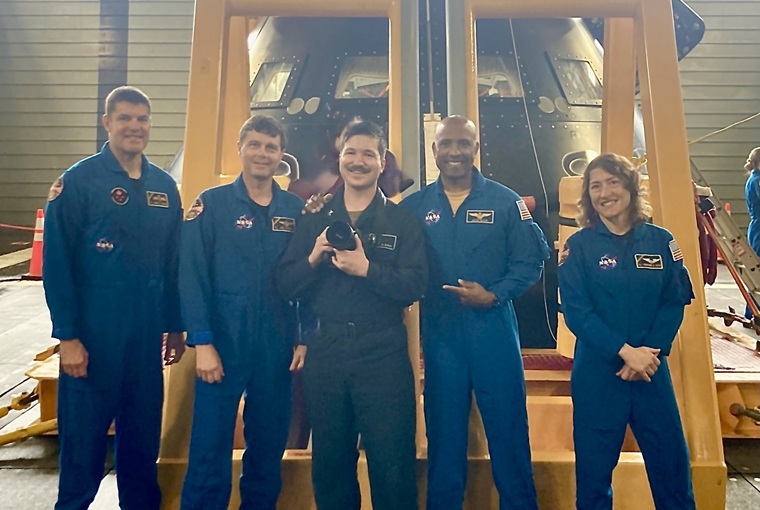
When the Orion spacecraft splashes down in the Pacific Ocean, it will be a historic moment for the Artemis II crew. It will also be a sight one U.S. Naval War College sailor has seen before.
Mass Communication Specialist 2nd Class Connor Burns was one of two U.S. Navy photographers competitively selected to support the Underway Recovery Test (URT) 11 in February of 2024.
It was the eleventh in a series of such tests, but the first time the Department of War and NASA completed a full recovery simulation with the Artemis II Flight Crew.
The Artemis II mission was the first crewed flight of NASA's Space Launch System (SLS) rocket and Orion spacecraft, sending four astronauts on an approximately 10-day journey that took them beyond the Moon – farther from Earth than any humans have ever been. The mission marked humanity's first crewed voyage to the vicinity of the Moon in more than 50 years.
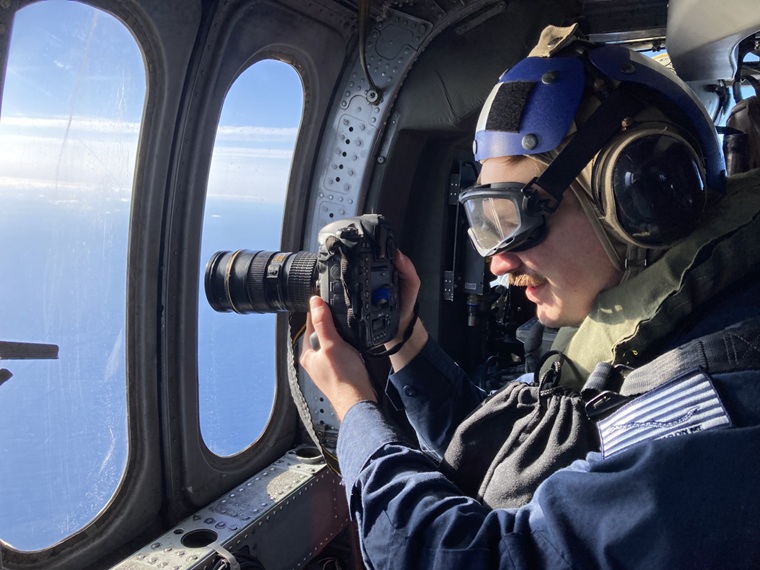 In order to earn his place on the URT team in 2024, Burns had to submit an essay and photography portfolio.
“From a very young age, I’ve taken a very strong interest in American history,” said Burns, who was assigned to the Wasp-class amphibious assault ship USS Boxer (LHD 4), at the time. “When I read that most astronauts come from the Navy, I knew I wanted to join the Navy. I ended up dropping the astronaut part and keeping the Navy part. But I never forgot that interest in astronauts and space. Getting to do the recovery test was a dream come true. And I’m thankful to the Navy and NASA for giving me that chance.”
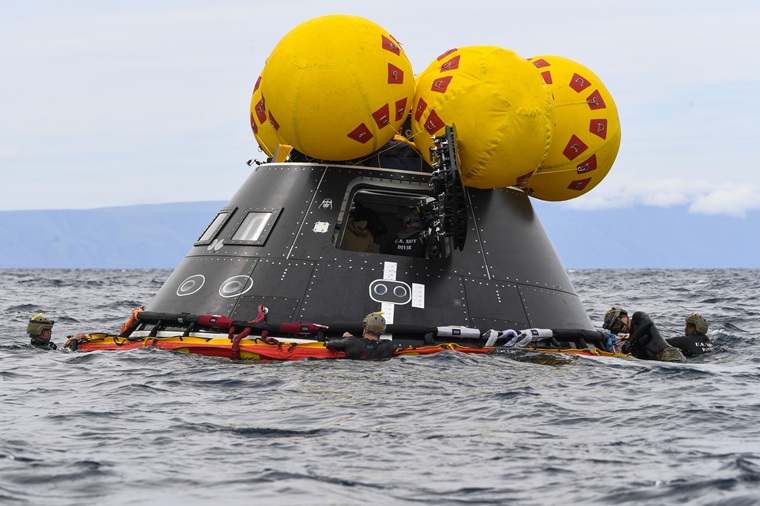
Artemis II NASA astronauts U.S. Navy Capt. Reid Wiseman, U.S. Navy Capt. Victor Glover, Christina Hammock Koch, and Canadian Space Agency astronaut Jeremy Hansen embarked aboard the amphibious transport dock USS San Diego (LPD 22) off the coast of San Diego for the 2024 exercise, which included refinements to the timing of crew extractions from the capsule; walk-through of post-mission medical evaluations; and day-and-night recovery procedures to support certification of personnel and processes for the eventual real-life recovery.
“The astronauts that I met, from what I saw of them, they were the types of leaders you would want to follow anywhere,” said Burns. “It was very clear that they had the prioritized the mission and also everyone around them. They were so grateful to the officers and sailors on – and attached to – the San Diego who were helping out in the URT.”
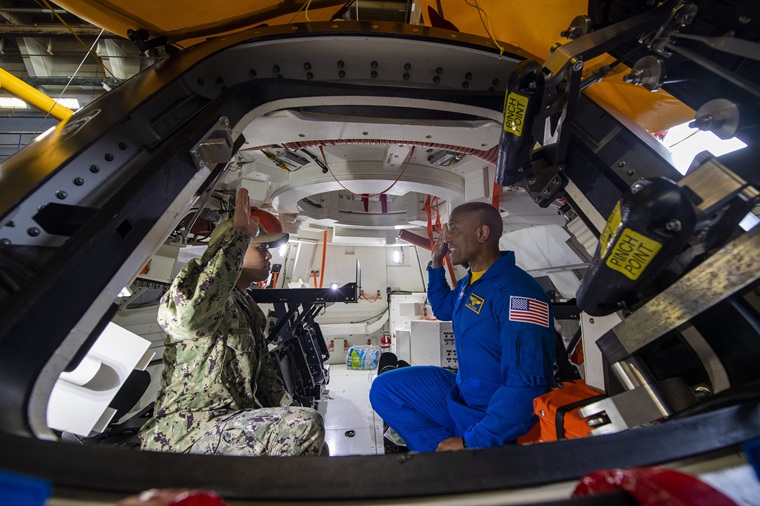 Burns said that Glover offered to re-enlist a sailor – Machinist Mate 2nd Class Gerald Castro – inside the historic space capsule.
“That speaks so much to Capt. Glover’s character,” said Burns.
As a Navy photographer, Burns accompanied NASA scientists in an MH-60S Seahawk helicopter to evaluate weather conditions for the recovery test, as well as Navy divers in a small boat deployed to practice retrieving the astronauts from the space capsule.
During the training, the Orion capsule was dispatched into the ocean from the USS San Diego well deck, the open water-level compartment at the base of the ship used to deploy smaller amphibious vessels, like Landing Craft Air Cushion (LCACs) hovercrafts.
Burns said he was able to look inside the capsule on a few occasions during the evolution.
“Comparing that technology with the technology I grew up seeing in the space shuttle program on TV as a kid, what they had on Orion is absolutely cutting edge,” he said.
The Artemis II mission is part of a series of increasingly challenging missions to explore more of the Moon for scientific discovery, economic benefits, establish an enduring human presence on the lunar surface, and lay the groundwork for sending the first astronauts to Mars. The mission launched from NASA’s Kennedy Space Center in Florida, April 1.
“I got the chance to speak to a few of the NASA scientists who were there,” Burns said. “We discussed the future of Artemis, and about how Artemis IV is the one that will land us back on the Moon. That’s going to be the starting line to Mars.”
 There are currently two U.S. Naval War College alumni in the NASA astronaut corps – U.S. Navy Capt. Jack Hathaway, currently aboard the International Space Station, and Lt. Cmdr. Jessica Wittner.
The war college has developed its Space Studies Group to increase offerings in the subject matter as U.S. space exploration efforts continue and expand. Current electives include classes on space weather effects on military operations, space technology and missions, and space and national power.
Burns said that in his essay submission to join URT 11, he wrote that he was motivated to be part of history.
“For the longest time, mankind has stared up at the heavens and wondered ‘what if,’” he said. “And now Artemis is the next step in answering that big question.”
NWC delivers excellence in education, research, and outreach, informing today’s decision-makers and educating tomorrow’s leaders. The college provides educational experiences and learning opportunities that develop students’ ability to anticipate and prepare strategically for the future, strengthen the foundations of peace, and create a decisive warfighting advantage.
About this News Article
Article Information
April 11, 2026
Most Recent
News, Media, & Events
U.S. Naval War College Alumni Join Next Generation of Astronauts
Mar. 07, 2024
News Publication
U.S. Naval War College Hosts Discussion Between Falklands War Veterans
Apr. 06, 2026
News Publication
2026 Cyber & Innovation Policy Institute Summer Workshop
May. 27, 2026
8:00 AM
U.S. Naval War College, 686 Cushing Road, Newport, RI 02841
Floating Red Crosses: An Exploration into the Global Hospital Ship Ecosystem Using Open-Source Data
Apr. 11, 2026
Expeditions by MCUP
Article Publication