
Maritime Security and Governance Staff Course Graduates 27 Officers
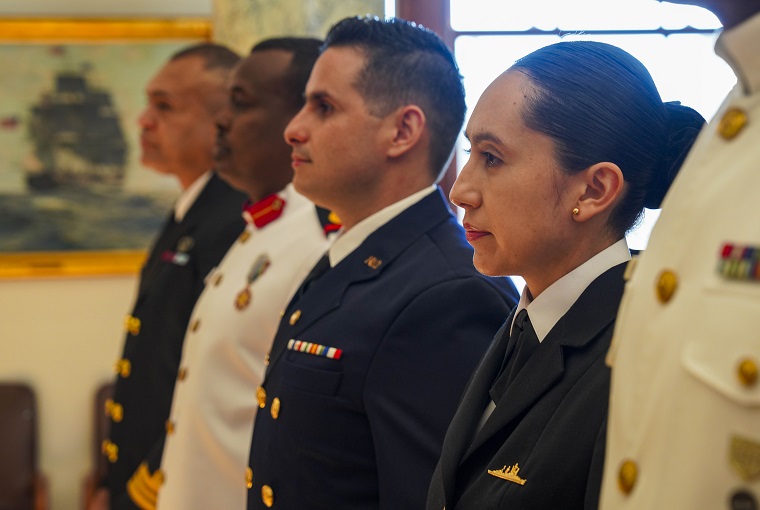
The U.S. Naval War College International Programs department graduated 27 officers from its Maritime Security and Governance Staff Course (MSGSC) at the war college’s Newport, Rhode Island, campus Friday, Feb. 27.
The graduates of the 22-week course represented 25 countries from across five continents, and most are between the ranks of O-3, or the equivalent of a navy lieutenant, and O-5, or the equivalent of a navy commander.
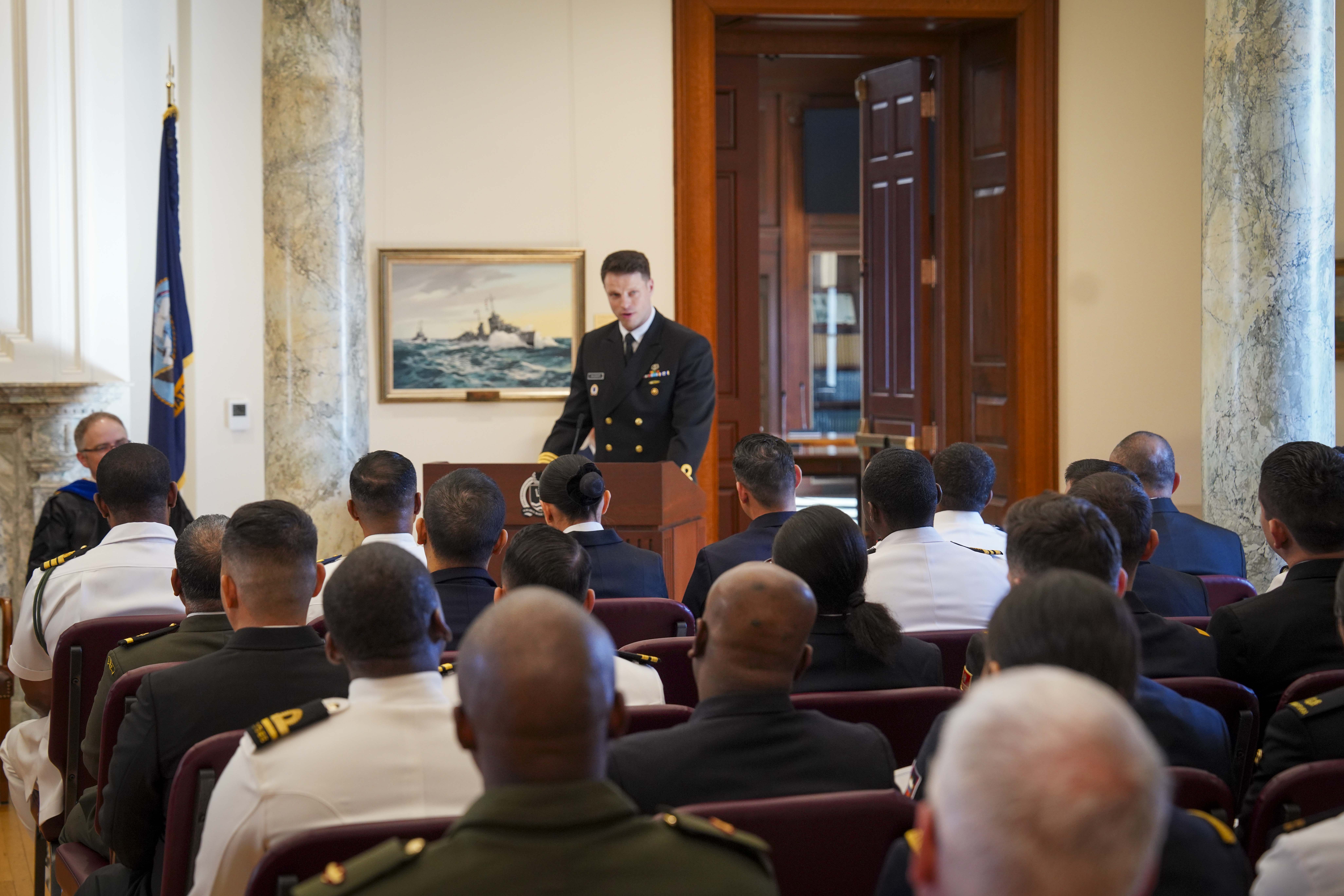 Among the distinguished visitors in attendance Friday were Brig. Gen. Thomas Hannon of the Rhode Island National Guard; Mexican Embassy Naval Attaché Rear Adm. Cuauhetemoc Gonzalez Woolrich; Commodore Wajdi Kriaa, military adviser to the Permanent Mission of Tunisia to the United Nations; and Capt. James Francis P. Lugto, Naval Attache from the Republic of the Philippines.
“This course strengthens the already unbreakable bond between the U.S. military and our allies and partners around the world,” said Naval War College President Rear Adm. Darryl Walker. “The relationships we foster here will continue on as these global military leaders advance in their careers and ensure we’re able to operate together seamlessly as unified forces around the world long into the future.”
Dr. Curtis Bell, Capt. Jerome E. Levy Chair of Economic Geography and National Security and director of the Maritime Security and Governance Staff Course, spoke at the ceremony about the history of seapower and maritime security, how it can be leveraged to provide safety and stability for all nations, and the vigilance necessary to leverage it.
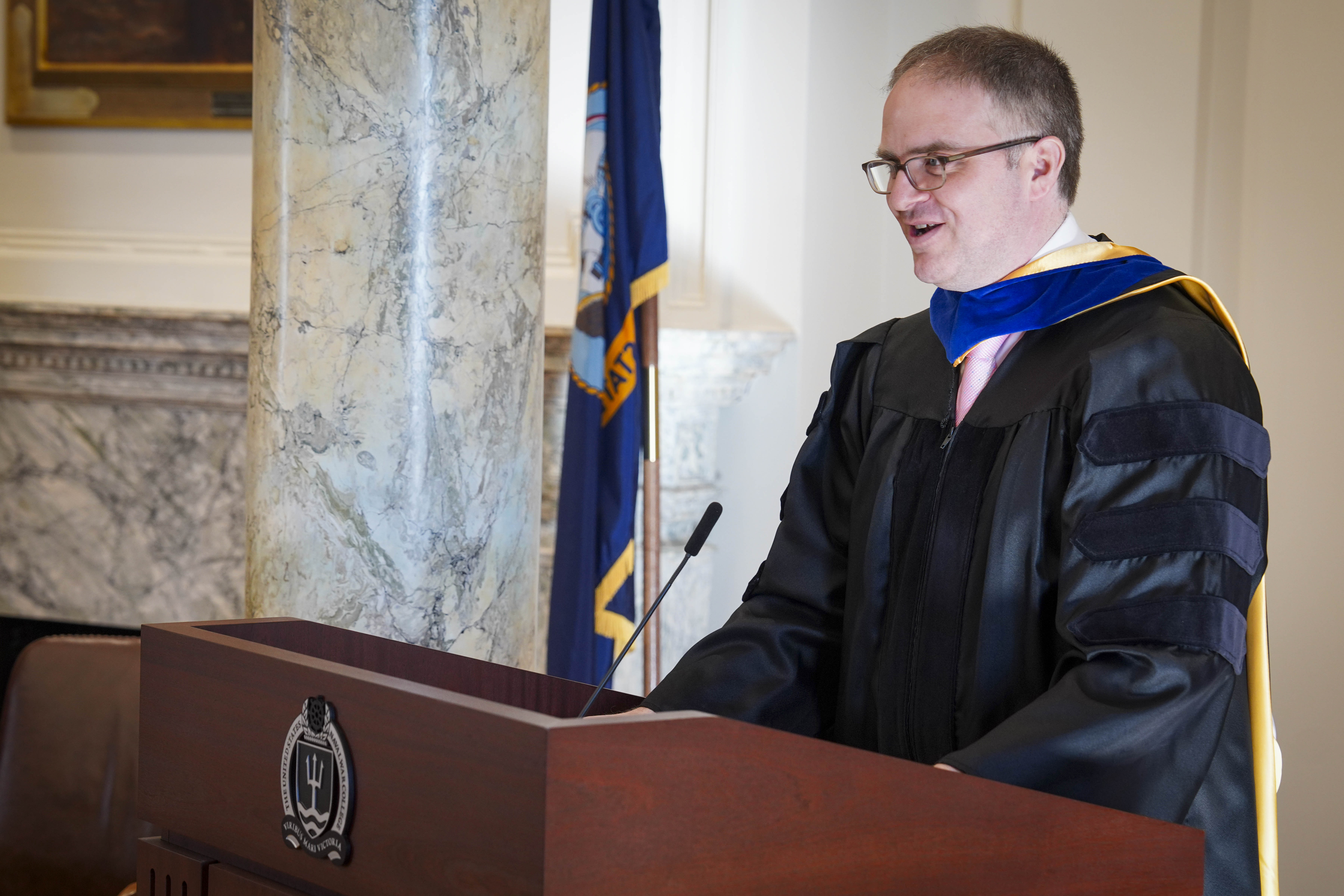 “We must not forget that this phase of unrivaled wellbeing across the world brought on by peace at sea is not a new normal, the future is not guaranteed,” he said. “Maintaining what we have requires vigilance. It requires cooperation, coordination, communication and – if necessary – mutual defense.”
Since its inception in 2022, more than 130 officers from more than 50 partner and ally nations have gone through the war college’s MSGSC course.
The three-phase course begins in late September with foundations classes on core topics such as maritime law, multinational cooperation and military operational design. It continues into an applications phase in November and January, focusing on security challenges, such as threats to shipping, trafficking of illegal substances and maritime border security, while also including work developing maritime security strategies. MSGSC is completed with February capstone projects, during which officers work in groups to study maritime challenges and propose solutions involving multinational operations.
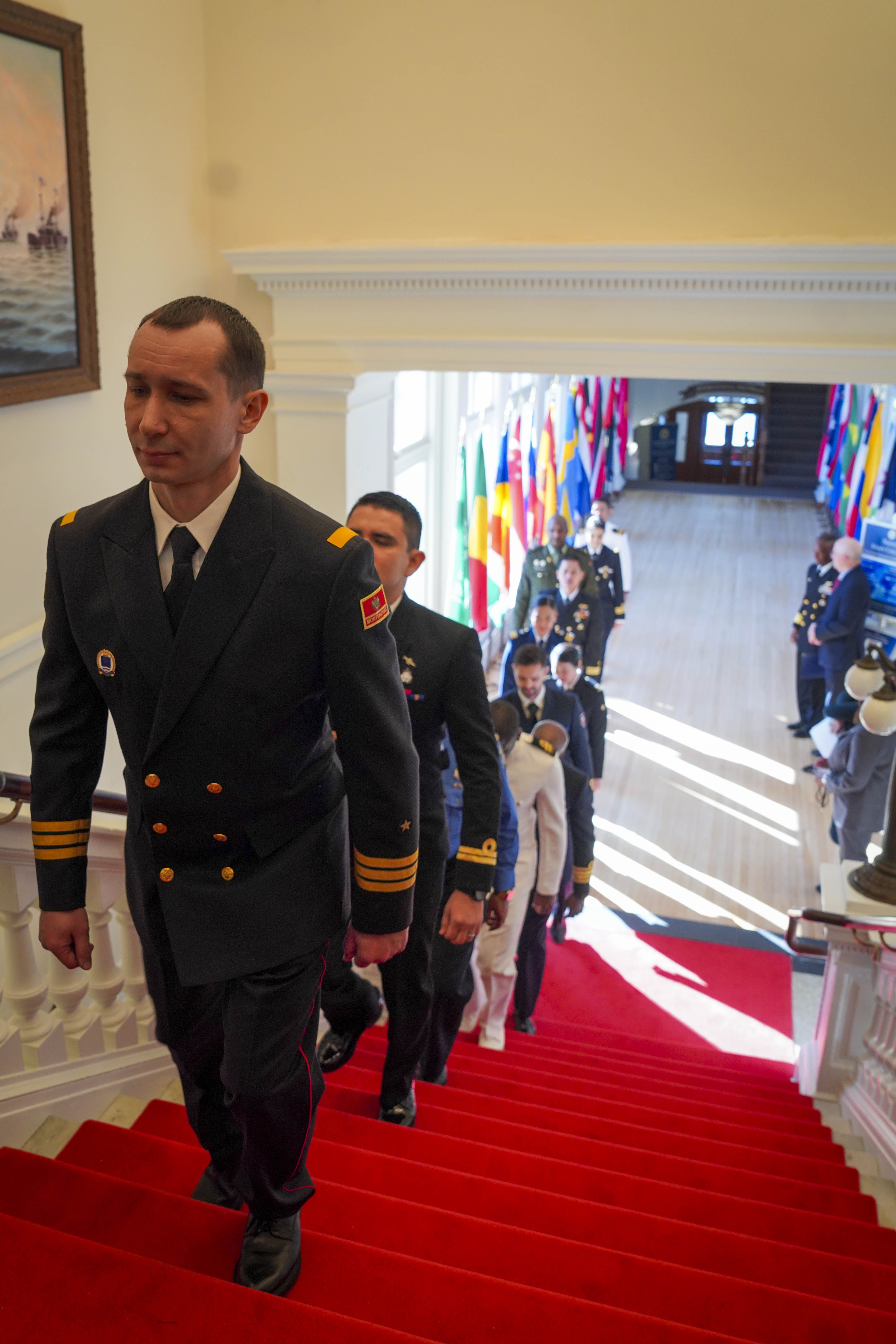 Lt. Cmdr. Thomas Naujokaitis of the Lithuanian Navy, the MSGSC class president, earned the Leadership Award and provided remarks on behalf of the class, highlighting that the NWC curriculum is “about finding certain tools to analyze complex problems.” He compared the five-month course to a tall ship, with the keel being strong war college leadership, all the way up to the mast and sails, represented by the students who moved the course forward with their solutions-based learning.
MSGSC is one of four international course offerings at NWC, directly supporting the development of robust global maritime partnerships. Others include the Naval Command College (NCC), the Naval Staff College (NSC) and the International Maritime Staff Operators Course (IMSOC).
Once graduated, officers maintain the connections they’ve built at NWC through participation in a global alumni network of more than 50,000 military and government leaders around the world, complete with international events, networking platforms and other online resources.
Established in 1884, NWC is the oldest institution of its kind in the world. The college delivers excellence in education, research, and outreach, informing today’s decision makers, educating tomorrow’s leaders, and engaging partners and allies on all matters of naval power in order to preserve the peace, respond in crisis, and win decisively in war.
About this News Article
Article Information
February 27, 2026
Most Recent
News, Media, & Events
Cyber & Innovation Policy Institute Partners with The Army Cyber Institute at West Point on a Special Issue of The Cyber Defense Review
Feb. 12, 2026
News Publication
U.S. Naval War College Leaders On-hand as Alum Launches Into Space
Feb. 13, 2026
News Publication
U.S. Naval War College Graduation
Jun. 12, 2026
10:00 AM
U.S. Naval War College, 686 Cushing Rd, Newport, RI 02841
Europe Needs a Military Operations Center in Ukraine
Feb. 04, 2026
Center for European Policy Analysis
Article Publication