
U.S. Naval War College Student Proposes New Measures to Save the Lives of Wounded Troops on the Front Lines
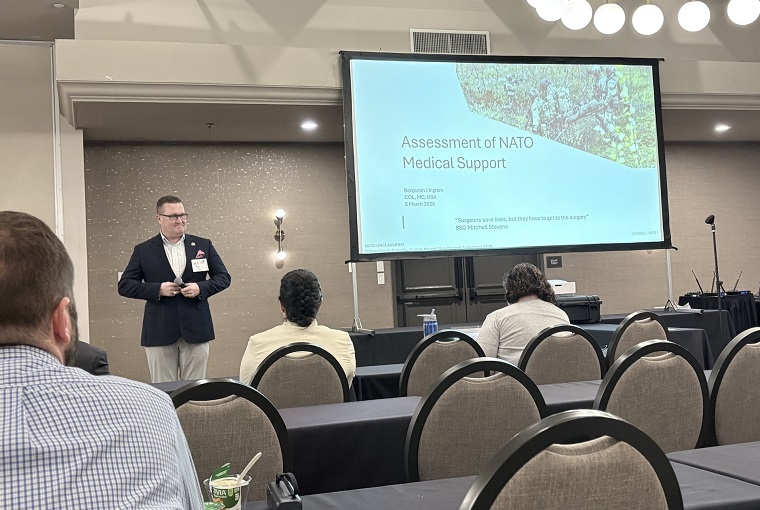
U.S. Naval War College (NWC) student and medical doctor Col. Benjamin Ingram, U.S. Army, spoke at the Defense Committee on Trauma (DCoT) working sessions in Washington, D.C., this month to propose new measures to improve treatment on the front lines of conflict.
Ingram’s presentation at the event was based on the research he conducted in the Joint Maritime Operations (JMO) course. He argued for the establishment of a standardized Combat Medical Technician (CMT) personnel rating among NATO countries and the development of a Prolonged Combat Lifesaver (PCLS) package – training and equipment to enhance fighting forces’ capabilities to keep wounded warfighters alive on the battlefield.
Prior to enrolling at the war college, Ingram worked at NATO’s Allied Special Operations Forces Command (SOFCOM) in Belgium, where he identified differences between allied militaries’ medical response capabilities.
“In that position, I gained a lot of understanding about the medical capabilities across the alliance,” he said.
He found wide variance between the scope of different countries’ military medical programs, impacting the numbers of combat medics– with some allies having none. These gaps create uncertainty in the care of wounded troops between the point of injury and their successful transportation to a hospital or other safe treatment facility, he said.
In grappling with this problem during his JMO research, Ingram determined that NATO should adopt standard nomenclature and training pipelines for battlefield medics – although because that term has different connotations in different countries, he proposed the title Combat Medical Technician.
He said the establishment of what could become a NATO-wide CMT corps would augment existing health care systems and be a critical force multiplier In a joint combined force, “this provides the commander expanded access to combat medical care and an assurance that the combat medical care meets at least minimum standards.”
So more people who can treat wounded warfighters on the front lines and better success rates among those who do.
“This is no different than what NATO did in terms of interoperability with ammunition and fuel,” he said. “They came up with common ammunition and fuel standards and left it up to the countries on how to meet those standards. That way, different countries can rearm and refuel each other. This way, different countries could more capably treat each others’ wounded.”
To further improve that success rate and buy time for injured personnel in austere or dangerous environments, Ingram proposed the PCLS – pronounced “pickles” – packages.
“The task of the medical force is to keep people alive until we can get them into more advanced medical services,” he said. “The PCLS provides the resources forward in the absence of those trained medical personnel to keep the patients alive as long as possible.”
An addition to the initial-response Combat Lifesaver (CLS) treatment, the PCLS would consist of standardized equipment and replenishment kits, either transported with fighting forces or dropped into conflict areas by aircraft or unmanned systems, he said.
The packages could consist of wound care dressings, freeze dried plasma, warming blankets, antibiotics, pain control medicines and potentially more advanced technology, such as portable remote monitoring systems.
Unit commanders could invest in training to ensure personnel on the battlefield could use the additional gear and keep wounded troops alive for longer periods of time.
“One of the many benefits of attending the Naval War College is that it allowed me the space to use my operational and tactical experience to develop solutions to real challenges our soldiers might face in a combat zone,” said Ingram, who is enrolled in the College of Naval Warfare’s senior-level program. “The work we do here not only prepares us as individuals to lead forces, but also to innovate and solve problems to win wars.”
Founded in 1884, NWC informs today’s decision-makers and educates tomorrow’s leaders by providing educational experiences and learning opportunities that develop their ability to anticipate and prepare strategically for the future, strengthen the foundations of peace, and create a decisive warfighting advantage.
About this News Article
Article Information
March 13, 2026
Most Recent
News, Media, & Events
Maritime Security and Governance Staff Course Graduates 27 Officers
Feb. 27, 2026
News Publication
U.S. Naval War College Celebrates Spring 2026 Graduates
Mar. 06, 2026
News Publication
Current Strategy Forum
Jun. 08, 2026
8:00 AM
Hybrid Event
A Way Out of the House of Dynamite
Mar. 09, 2026
USNI Proceedings
Article Publication